Levi Abbott - October 22nd, 2025
Back when computers ran on 5¼" floppy disks, one brand used an elephant as its mascot with the tagline, “An elephant never forgets.” I, unfortunately, can’t make that claim. But I do remember a few things—like soundcards you could install in your early IBM-compatible PC to upgrade the single channel sound of early video games. In 1992, Creative Labs sold a SoundBlaster bundled with free demo software to showcase the power of the SoundBlasters circuitry. One program in the bundle, Dr. Sbaitso, mesmerized me. You could type in your random thoughts, and your computer would talk back. If you were careful and thoughtful, you could even hold a rudimentary conversation. The future, filled with computers was inspiring*. Dr. Sbaitso caused me to excitedly imagine a brilliant future transformed by talking machines, sadly what we actually got was malevolent cable support bots, diabolical credit card phone menus, and telemarketing robocalls.
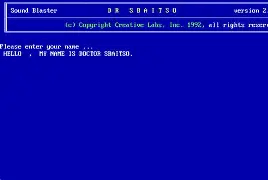
Despite a modicum of advancement since my beloved Dr. Sbaitso, AI has potential or perhaps better said great opportunity to be inadequate or even hazardous if uncritically accepted. I have remained unimpressed (and a bit disillusioned) even with real world AI like ChatGPT and Microsoft Copilot, tools which despite access to the data of an entire internet and powered by processors making trillions of computations per millisecond, sometimes feel only marginally more advanced than the dear Dr. Sbaitso of forty some years past. However, when I read a news item recently telling of a woman that allegedly won a lawsuit using AI (specifically Perplexity.ai) which per the article is a mere $20 a month. I was inspired to action, and downloaded perplexity’s Comet browser, entered my credit card. Then sat for a while considering a suitable task to undertake with my $20 investment.
Solving world hunger seems ambitious. Defeating communism... I settled on something more practical and less lofty. Improving our company website, coppercare.com. I asked the perplexity AI to analyze the site then make suggestions regarding content and keywords to boost search rankings.
I received rather boilerplate advice, tweak metadata titles and descriptions, utilize internal page linking, and use Structured Data Markup. Quite rudimentary and already implemented. But the AI proffered keyword suggestions to add “environmental wood protection” and “eco-friendly lumber preservatives” gave me pause. Our products, wood preservatives are legally pesticides. Pesticides are regulated by the EPA under FIFRA the Federal Insecticide, Fungicide, and Rodenticide Act. That means you can’t legally describe (or imply, or infer) a pesticide as “safe,” or “harmless,” “eco-friendly,” or “environmental” (40 CFR 156, to be exact).
I immediately queried perplexity asking if using those keywords might be illegal, and received cheerful, “Yes!” along with a detailed explanation of FIFRA, EPA guidelines, and EPA memorandums of understanding on the subject of misleading claims.
I have canceled my monthly subscription to perplexity.ai and for now will continue to do things in the manner I am accustomed to.
But the experiment did cause my little grey cells to consider how businesses (which judging by Nvidia's stock price are all in on AI implementation) and especially young professionals are using these AI tools. I’m old enough to know the nuances of my field. But if I’d received this advice 30 years ago, I would have blissfully broken federal law.
How often are AI tools utilized and causing real harm, when used as a substitute for real world experience?
My knowledge of wood preservatives and the laws and regulations governing them isn't an accident. It has been gained through years of experience working in my industry. For the moment, I will not be replaced with silicon chips and lines of code. Despite a recent CNBC headline proclaiming, "Bill Gates: Within 10 years, AI will replace many doctors and teachers-humans won't be needed 'for most things'". I respect Mr. Gates, his vision profoundly impacted society and technology. But I shall remain skeptical. Personally, I have no doubt that AI tools are here for the long term. AI tools will probably even get better. Even before AI most people's first instinct was to search Google or YouTube instead of a technical reference. And with that tendency in mind, perhaps companies and managers should scrutinize how their employees are using AI tools and evaluate how to review and use AI generated or assisted work product.
* (Don't take my word for any of this through a bit of emulation magic and the power of HTML5 you can experience the magic of Dr. Sbaitso at Classic Reload for yourself without dragging your old IBM PS/2 up from the basement)